
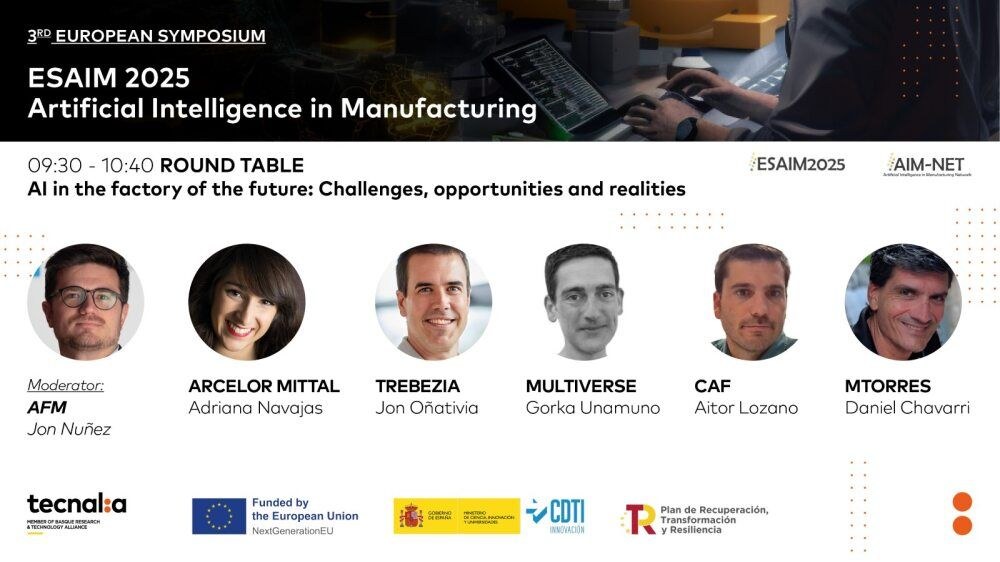
Bilbao, October 8, 2025. — Jon Oñativia, CEO and co-founder of TrebezIA, participated on October 8 in the roundtable "AI in the Factory of the Future: Challenges, Opportunities and Realities," as part of the ESAIM 2025 symposium organized by Tecnalia in Bilbao. The event, focused on the application of artificial intelligence in manufacturing, brought together representatives from leading industrial companies in the Basque Country and beyond: Multiverse Computing, ArcelorMittal, CAF, and MTorres Diseños Industriales.
Oñativia joined Daniel Chávarri, Gorka Unamuno, Adriana Navajas Guerrero, Aitor Lozano, and Jon Núñez Barrenechea to address three central topics: how AI manages uncertainty in dynamic industrial environments, the role of ethics and privacy in AI system development, and what single industrial problem unlimited AI capabilities would solve first.
1. AI as a tool for reasoning under uncertainty
«Logistics often involves highly dynamic and unpredictable environments. How does AI help you manage uncertainty and adapt your solutions in real time?»
Oñativia framed uncertainty as an inherent condition of intralogistics — unpredictable human motion, changing layouts, variable lighting, unexpected obstacles — and rejected the approach of trying to eliminate it. TrebezIA's proposition is the opposite: design systems that embrace uncertainty and operate intelligently within it.
At the perception level, TrebezIA's systems use probabilistic models to quantify detection confidence and predictive neural networks capable of anticipating environmental evolution, including human and vehicle trajectories. On the control side, reinforcement learning combined with model predictive control (MPC) enables decision re-evaluation every few milliseconds, maintaining robot safety and efficiency even as the environment shifts. At the fleet level, AI-driven coordination dynamically reallocates tasks and routes in response to real-time demand.
"AI doesn't remove uncertainty — it allows the system to reason under uncertainty and act intelligently despite it."
— Jon Oñativia, ESAIM 2025
2. Ethics and privacy built in from the start
«Do you take ethical and privacy aspects into account when developing and/or implementing AI-based solutions?»
Oñativia emphasized that ethical and privacy considerations are not an afterthought at TrebezIA — they are an architectural decision made from day one. The company applies edge AI principles: data processing, especially video and sensor data, is handled locally on the robot itself, minimizing transmission and protecting warehouse worker privacy. Where data must be stored or shared, it is anonymized and stripped of any personally identifiable information.
Explainability was another key theme: TrebezIA's systems are designed so that critical decisions — why a robot stopped or replanned its route — can be understood and audited. Ethically, Oñativia advocated for a vision of AI as collaborative intelligence that enhances human capabilities, not as technology that replaces people.
"We see AI not as a replacement for people, but as a collaborative intelligence that enhances human capabilities and quality of work."
— Jon Oñativia, ESAIM 2025
3. The cognitive industry as the next frontier
«If you had unlimited AI capabilities tomorrow, what's the one industrial problem you'd solve first?»
Rather than pointing to an incremental improvement, Oñativia described a paradigm shift: full cognitive orchestration of the entire factory or warehouse. The vision he outlined imagines all robots, machines, and people connected through a shared intelligence that understands context, goals, and constraints in real time — continuously optimizing logistics flows, energy consumption, and production schedules.
"Today we optimize individual processes or machines. With unlimited AI, we could optimize the entire ecosystem holistically," he explained. This leap represents, in his words, the transition from Industry 4.0 — automated — to the cognitive industry: a system that learns, reasons, and self-organizes.
"That's the transition from Industry 4.0 — automated — to the next step: the cognitive industry, where the system learns, reasons, and self-organizes."
— Jon Oñativia, ESAIM 2025
TrebezIA in the Basque industrial ecosystem
TrebezIA's presence at ESAIM 2025 — alongside companies such as ArcelorMittal, CAF, and MTorres — reflects the recognition the startup is earning in the Basque industrial ecosystem barely a year after its founding. Its origins as a Tecnalia spinoff and the technical depth of its proposition allow it to engage in high-level forums and contribute to the debate on industrial digital transformation with a distinctive and credible voice.


