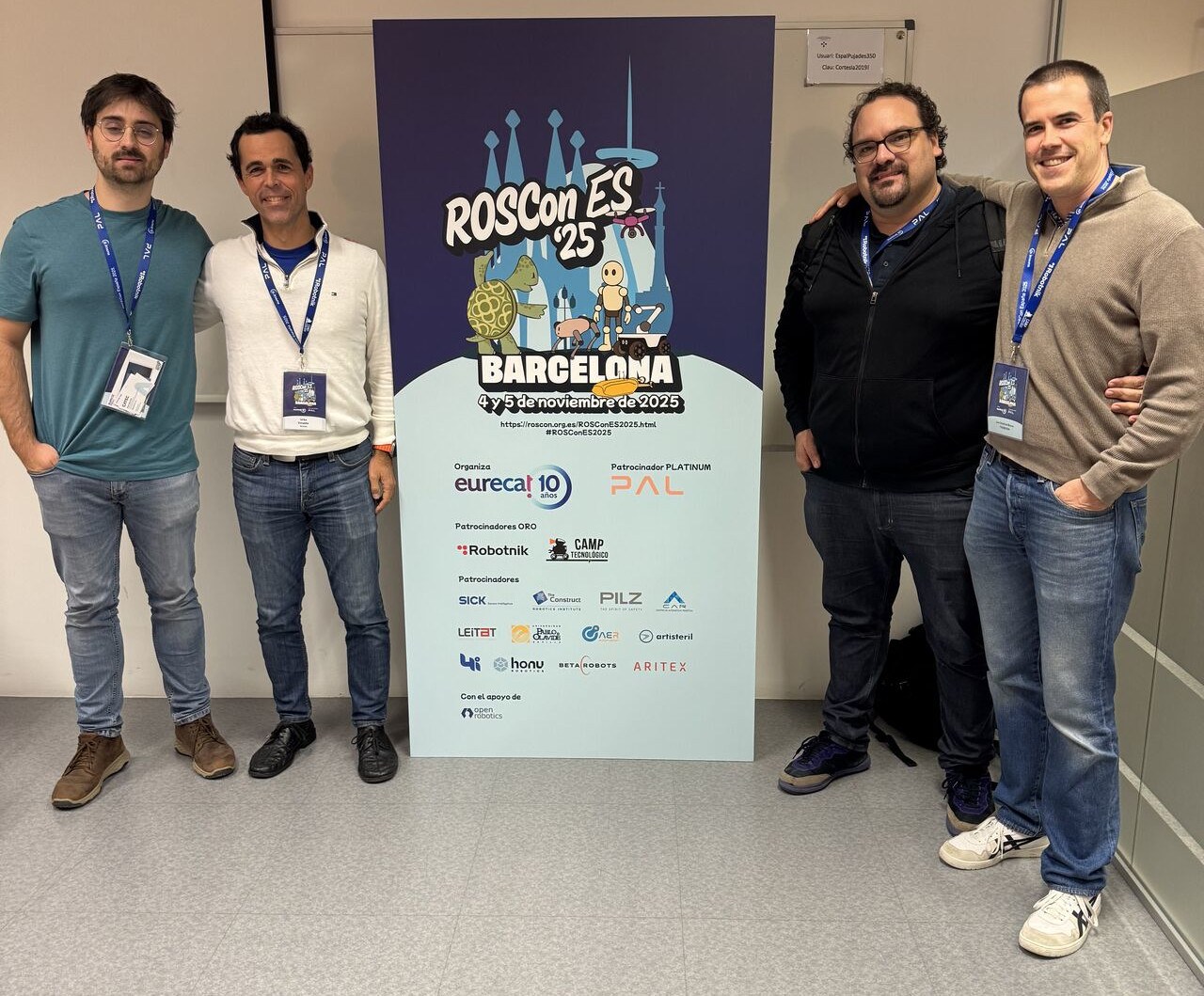
Barcelona, November 4–5, 2025. — Jon Oñativia, CEO and co-founder of TrebezIA, delivered a presentation at ROSCon ES 2025, the leading ROS (Robot Operating System) community event in Spain, held in Barcelona and organized by Eurecat - Technology Centre. The conference brought together the country's top robotics experts, and TrebezIA was featured as one of the industrial use cases in the official programme.
Oñativia was joined by Urko Esnaola, Andrés Montaño, and Javier González Huarte — his former colleagues at Tecnalia — reflecting the close ties TrebezIA maintains with the research ecosystem from which it emerged. The presentation covered how the startup has built Mairon's technical stack on ROS 2 and what lessons have been learned in the process of taking that development from an academic environment to a commercially viable industrial product.
ROS 2 as the backbone of Mairon's technical stack
The choice of ROS 2 as the foundation for Mairon's development was deliberate. The maturity of the ecosystem and the availability of high-quality specialized packages allow TrebezIA to avoid reinventing the wheel in well-solved areas and focus its R&D effort where it genuinely adds differentiated value.
Mairon's ROS 2 stack includes the following key components:
MoveIt 2: the reference package for manipulation trajectory planning, used to manage Mairon's robotic arm with proven reliability.
Nav2: the mature and widely validated autonomous navigation stack that TrebezIA uses as the foundation for robot navigation.
Zenoh: a modern communication middleware adopted by TrebezIA for its performance and suitability for distributed environments with low-latency requirements.
ROS 1 / ROS 2 bridge: the base navigation robot used in the prototype is a MIR, whose navigation stack runs on ROS 1. A bridge integrates it into Mairon's ROS 2 environment, preserving compatibility without abandoning the target architecture.
Proprietary vision algorithms: the visual perception module — object identification, barcode reading, pose estimation — is developed entirely by TrebezIA and constitutes one of its key differentiating technological assets.
"ROS 2 allows us to integrate the best of the open source ecosystem in areas where the problem is already solved, and focus our own development where it truly matters. That significantly accelerates time-to-market."
— Jon Oñativia, ROSCon ES 2025
From prototype to product: the industrial TRL challenge
One of the central messages of the presentation was the distinction between a proof of concept and an industrial product. Oñativia was explicit: building a system that works in a lab is only the starting point. Bringing that system to a level of technological readiness (TRL) sufficient to operate robustly in a real warehouse — with people, operational variability, and availability requirements — demands a very different kind of engineering work from research.
This distinction is particularly relevant in the ROSCon context, where the audience combines academic and industrial profiles. TrebezIA deliberately positions itself at the industrial end: a company that uses tools from the research ecosystem — such as ROS 2 — but with its focus firmly on the reliability, integrability, and scalability expected of a commercial product.
Known ecosystem limitations: PLC integration
The presentation did not sidestep real friction points in the ROS ecosystem for industrial contexts. Integration with PLCs (Programmable Logic Controllers) — ubiquitous in industrial automation — remains an area where ROS does not yet offer sufficiently mature solutions. This is an ecosystem-level limitation, not specific to TrebezIA, that affects any team attempting to deploy ROS-based robotics in industrial plant environments with existing OT infrastructure.
Acknowledging this gap openly before a specialized technical audience is consistent with TrebezIA's approach: build on what works, be honest about what does not yet, and contribute to the ecosystem's progress from the reality of industrial development.
Open source and intellectual property
TrebezIA builds on an open source ecosystem and deeply values that community. However, the complete Mairon solution — including the proprietary vision algorithms and integration architecture — is not available as open source. This is a deliberate and necessary decision to protect the technological value the company has generated, which underpins its business model and future financing capacity.